Success of debut Edward Capern Festival and 'Postman Poet' competition
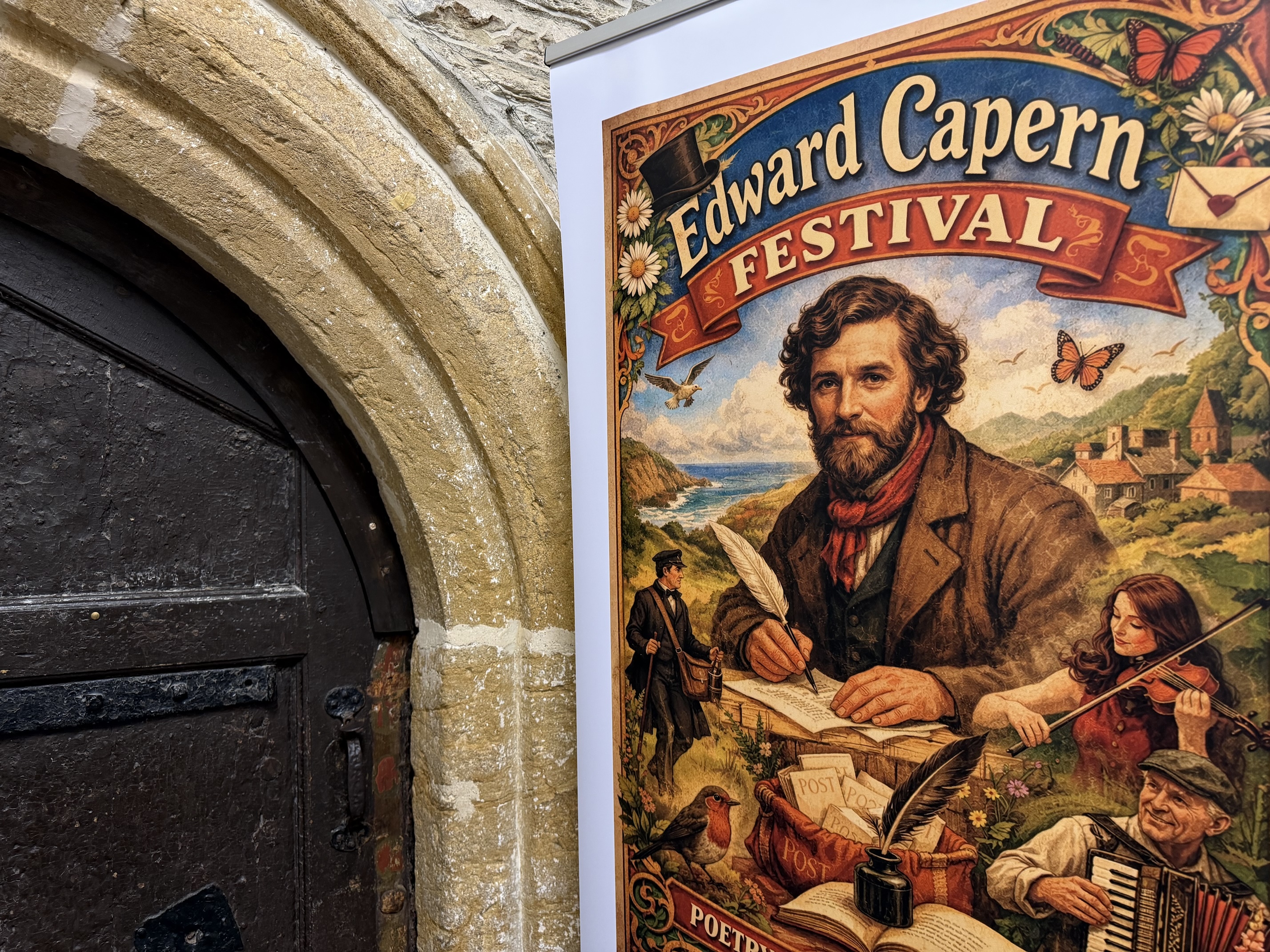
Devon’s first Edward Capern Festival honouring the ‘Postman Poet of North Devon’ looks set to become an annual event in the village of Heanton Punchardon, following its successful launch on Devon Day (Thursday, 4 June 2026).
The two-day festival, sponsored by Devon CPRE, the charity that works to protect and celebrate Devon’s countryside, resulted in a sell-out first night of poetry and music telling the story of the feted local poet. The second day of the festival showcased artwork by local children and some standout poetry by both published and emerging local talent.
Edward Capern (1819 - 1894) composed a wealth of poems and songs about the Devon countryside while going about his job delivering the mail to far-flung villages. He became famous throughout Victorian England. He died in Braunton and was buried in the churchyard at St Augustine’s in Heanton Punchardon.
Opening the festival, Steve Crowther, who chairs both Devon CPRE and the Heanton Punchardon Residents’ Committee, told the audience at St Augustine’s Church, “For quite a long time we have been conscious that we had a celebrity in residence in the village. For 132 years, in fact. A man who was praised by the Poet Laureate and was given a national pension by Lord Palmerston. So, we really wanted to recognise Edward Capern and to put him back on the map.
“At Devon CPRE, the Campaign to Protect Rural England, we basically make a nuisance of ourselves trying to prevent our beautiful countryside being despoiled. All of us at Devon CPRE thought it was a really good idea to do something positive and celebratory in our centenary year, and here we are! Edward Capern loved North Devon as much as we do, so we are incredibly pleased to kick off what we believe will be, and hope will be, the first in a long series of Edward Capern Festivals.”
Steve’s opening address was followed by An Evening of Music and Poetry to celebrate the life, poems and songs of Edward Capern, presented by local author Liz Shakespeare, an authority on the poet, alongside musicians Nick Wyke and Becki Driscoll.
The second day showcased art, poetry, displays and choral music created by local schools and residents for an exhibition at Wrafton Hall, based around six of Edward Capern’s best-known poems about the North Devon countryside. The festival concluded with the announcement of the winners of the ‘Postman Poet’ competition.
The winner of the inaugural Postman Poet Competition was Barnstaple resident Alan Craddock. His poem Drystone Wall blew away the judge, author Liz Shakespeare, and the audience who were privileged to hear Alan read it aloud. His highly-applauded entry won him the £500 first prize, and a second poem he submitted won him a Commendation.
Alan, originally from Redditch near Birmingham, has lived in North Devon for around fifty years. He started writing poetry a couple of years ago and has only written about half a dozen poems to date.
Alan says, “I was quite surprised I’d won; I have to be honest. The first thing I wrote was a verse for a Christmas card, and I was intrigued by how difficult it was. I don’t read poetry; I don’t do any other writing; it’s something I dabble at. It takes me a very long time to write a poem, I can tell you that!
“I liked the idea of writing about a drystone wall because it’s a kind of monument, and the art of constructing them is dying. They just sit there gradually crumbling, and I thought it would be interesting to say something about them. I used the prize money to buy myself an iPad.”
Second place went to published poet Frances Corkey Thompson for her piece entitled What the Sheep Told Me, or A North Devon Lesson in Love. Frances, who runs a small poetry group in Ilfracombe, says, “Marriage brought me to Devon, where I continued to teach. With retirement, I began to take my poetry more seriously. These days I tend to revisit earlier poems to see how the years have treated them. When I was invited to enter this competition, I looked out a poem I’d written about a sheep and reworked it slightly to make it more relevant to North Devon, although you can have an over-the-fence conversation with a sheep anywhere in rural England.”
Frances adds, “Despite my love of poetry, I’d never heard of Edward Capern, so I was delighted to learn of him and very much enjoyed the presentation on the festival’s opening night.”
Paul Osborne took third place with Changing Times. Paul says, “Once I found out who the event was being sponsored by, I got quite inspired. Steve Crowther told me my poem encapsulated everything that CPRE stands for. I wrote it specifically for the competition. I’ve written the odd poem over the years. I started writing poetry during Covid, when I couldn’t get out to buy my wife a Christmas, birthday or anniversary card. My wife likes a few words, so I started writing verses to put in her cards. It’s just gone on from there.”
To watch highlights of the festival, go to CPRE Devon’s YouTube: The inaugural Edward Capern Festival, sponsored by Devon CPRE.
Edward Capern Festival 2026 Postman Poet of the Year Award – Winners
WINNER
Drystone Wall: Alan Craddock
Each knuckled rock, each catch and snag holds its next in firm embrace,
All enduring, cold and brutal, but with unintended grace.
Stubborn straight, blindly brailling, ’cross the moor hard fingers read
the earth’s soft pulsing, bedrock shifting, student of time’s fickle speed.
Built when life was plain and spare, by mist-damp hearts with stunted lives,
stone on stone, year on year, kin on kin, the wall survives.
Built to last, built for order, sweat and hammer, pegs and cord,
raw blunt fingers, raw blunt minds, stripped of dreams by church and lords.
The wall today grows ancient greens of moss and lichen, patch and stain.
Pigment wash in summer heat, impasto oil in autumn rain.
No Banksy here, no DJ flier, guano splash the only tag;
No Sam loves Jude, no Names of the Fallen, no blue plaque for stoat or stag.
Dusk veils as weightless owl, softly beats and bobs and glides,
its stealthy hues speak its steel, what alchemy of tone abides?
October dawn, windswept beech, ochre brushed, racked but mute,
staggering drunk, the wall beside it lists from heave of straining roots.
A thousand years, shifting forest slips the rocks to scattered heaps.
Swelling oceans fish the nooks, moss undone by shimmering reef.
Fierce hot winds drive naked sand, covering all like blanket throw.
Floating spectral what-might-be-s in the crow black never-know.
Stirring mists of dark unease in the crow black never-know.
SECOND PLACE
What the Sheep Told Me, or A North Devon Lesson in Love: Frances Corkey Thompson
It was an over-the-fence conversation,
the fence on which she, or one of her sisters,
had left a yanked-out cloud of wool.
‘That must have hurt,’ I observed.
She eyed me with the one devil-eye
in the near side of her face, making it clear that
right now her business was concentrated chewing.
She heeded me as little as she heeded
the lamb bumping at her underneath,
tail going like a piston, and here was its twin
romping home to her over the field,
and not a sign from her of welcome or delight.
I asked her therefore if she thought that humans
sometimes acted out their feelings in rather
inflated gestures, and might love actually require
less display? And more proper attention?
This did not exercise her enough
to stop her munching, or trouble her lambs.
Love, she offered ruminatively, is to be given
freely and from a full heart
according to what is needed and when.
It can be nothing less. It is nothing more.
Her reply shone clear as the sun on the sea
that joyous North Devon spring morning.
THIRD PLACE
Changing Times: Paul Osborne
Sadly many things have changed,
since through this landscape Capern ranged,
horse and plough now long gone
as mighty tractors roar along,
no more flowers in the fields
as farmers strive to increase their yields,
pollution in our rivers and seas
causing a decline in fish species.
In the hamlets where he used to roam
every other house now a holiday home,
where the buzzards used to soar and swirl
now the giant turbines whirl
and to add to our dismay
in many fields a solar array,
even in the clear blue sky
the vapour trails as jets fly by.
But the beauty still remains
if you seek the quieter country lanes,
their banks of flowers under sunny skies
providing food for the bees and butterflies,
in the dappled shade of the trees
their branches whispering in the summer breeze,
or the fleeting aroma of petrichor
as fresh rain falls on the dusty floor.
And in the wild remoter places
you can still find the open spaces,
along the coast or on the moors
dotted with their rugged Tors,
or the valleys in between
where hidden gems still lie unseen,
wander the banks of the meandering stream
where sparkling kingfishers dart and gleam.
It’s here we spend our leisure hours
and hope they will be forever ours,
not for developers to destroy
but for us all to enjoy.
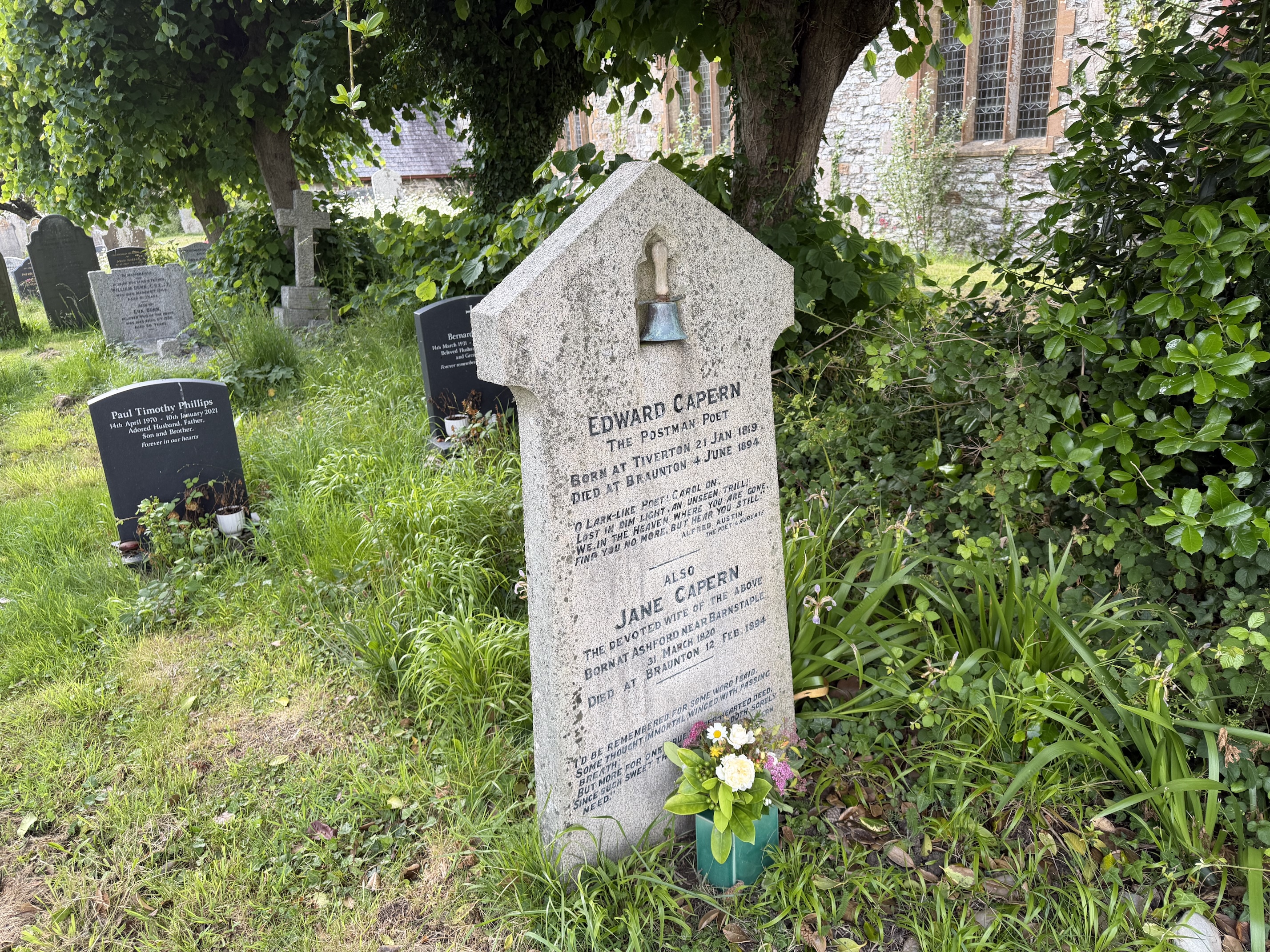
Edward Capern Grave at St Agustine's Church.
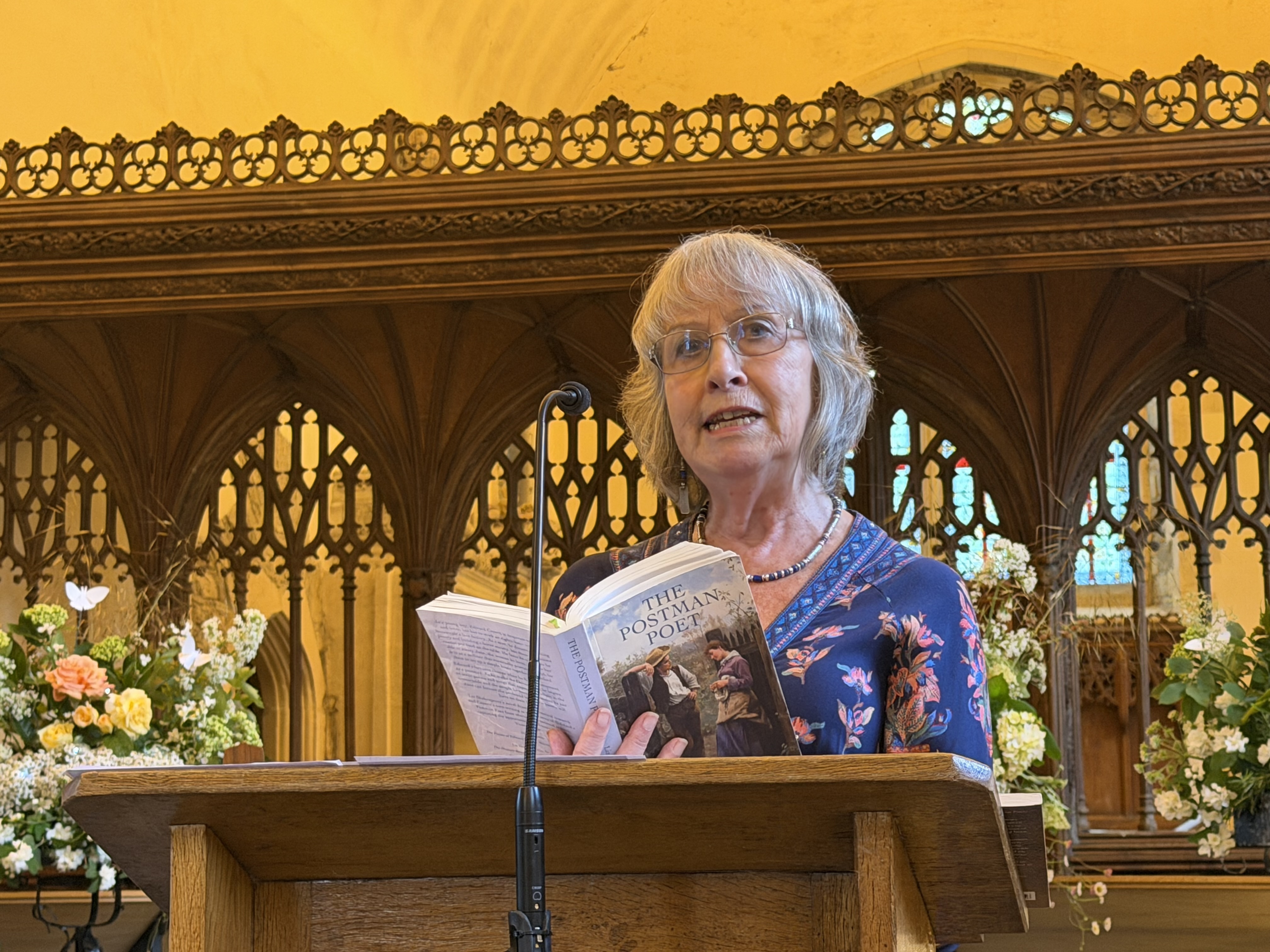
Presented by local author Liz Shakespeare, an authority on the poet.
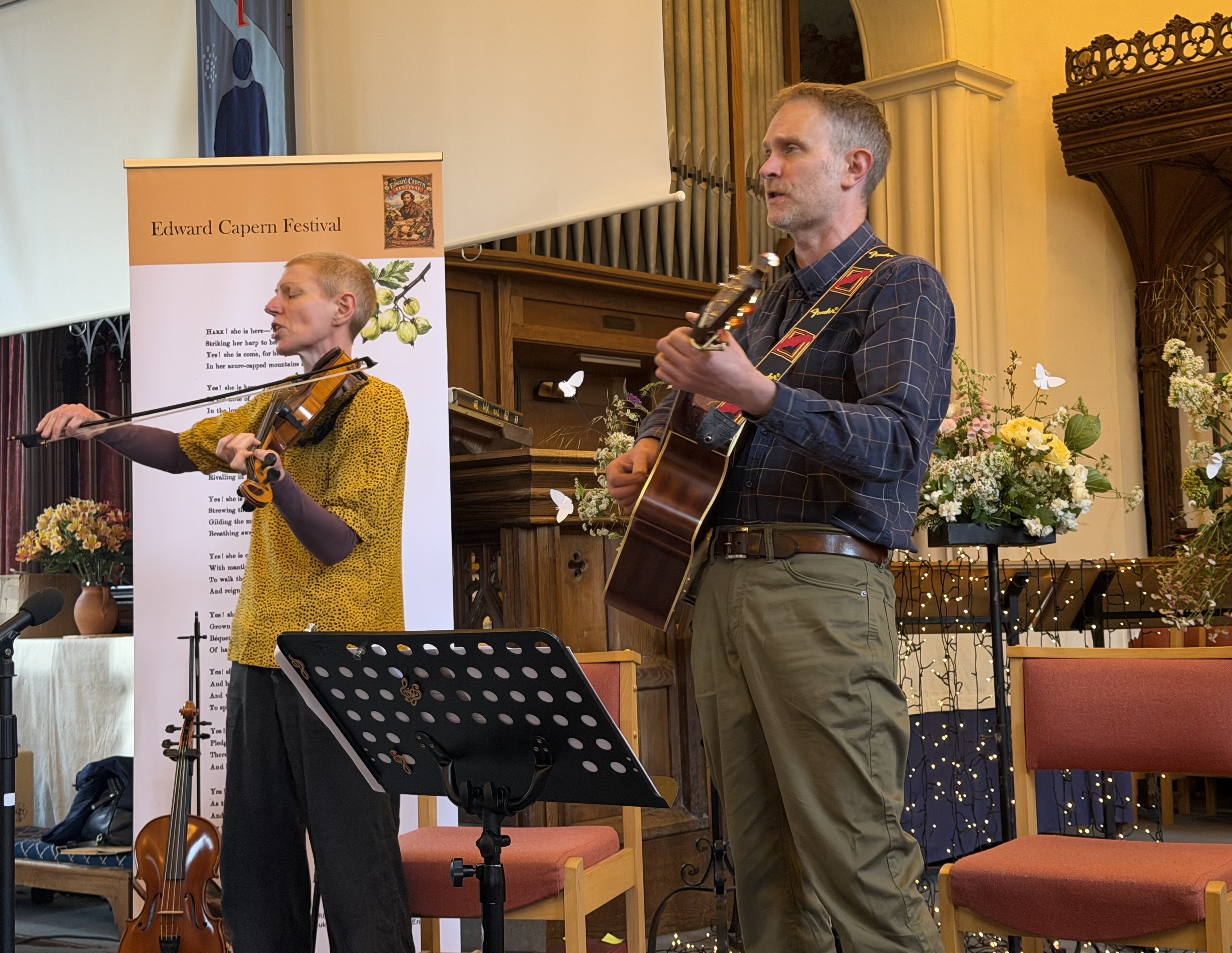
Musicians Nick Wyke and Becki Driscoll.